Friday, February 25

UPSC Indian Engineering Services Examination – IES 2011 Exam Schedule


UPSC IES Exam 2011 Date
A combined competitive examination for recruitment to the Services / posts mentioned in para 2 below will be held by the Union Public Service Commission at Agartla, Ahmedabad, Aizwal, Aligarh, Allahabad, Bangalore, Bareilly, Bhopal, Kolkata (Calcutta), Chandigarh, Chennai, Cuttack, Dehradun, Delhi, Dharwar, Dispur (Guwahari), Gangtok, Hyderabad, Imphal, Itaganar, Jaipur, Jammu, Jorhat, Kochi, Kohima, Kolkata, Lucknow, Madurai, Mumbai, Nagpur, Panaji (Goa), Patna, Portbolar, Raipur, Ranchi, Sambalpur, Shillong, Shimla, Srinagar, Thiruvanandapuram, Tirupati, Udaipur and Vishakhapatnam commencing on 14th May, 2011 in accordance with the Rules published by the Ministry of Railways (Railway Board) in the Gazette of India Extra-ordinary dated the 8th January, 2011.
UPSC Indian Engineering Service Examination – IES 2011 Exam Date: 14th May, 2011.
The Centres and the Date of Holding the Indian Engineering Service Examination as Mentioned above are Liable to be Changed at the Discretion of the commission.
while every Effort will be made to Allot the Candidates to the Centre of their choice for Examination, the Commission may, at their Discretion, Allot a Different Centre to a Candidate When Circumstances So Warrant.
Candidates Admitted to the Examination will be Informed of the Time table and Place or Places of Examination
The candidates should note that no request for change of centre will normally be entertained. However, when a candidate desires a change in centre from the one hehad indicated in his Application Form for the Examination, he must send a letter addressed to the Controller of Examination, Union Public Service Commission giving full justification as to why he desires a change in centre. Such requests will be considered on merits but requests received in the Commission’s Office after 7th March,2011 will not be entertained under any circumstances nor will such communications be replied to.
2. (A) Recruitment on the results of this examination will be made to the Services / Posts under the following categories :-
The number of vacancies to be filled on the results of the examination is expected to be approximately 745 including 50 PH vacancies. The number of vacancies is liable to alteration.
Reservations will be made for candidates belonging to Scheduled Castes, Scheduled Tribes, Other Backward Classes and Physically Disabled Categories in respect of vacancies as may be fixed by the Government of India.

Category I – Civil Engineering

Group A Services/Posts
  1. Indian Railway Service of Engineers.
  2. Indian Railway Stores Service (Civil Engineering Posts).
  3. Central Engineering Service.
  4. Indian Defense Service of Engineers (Civil Engineering Posts).
  5. Indian Ordinance Factories Services (Engineering Branch) (Civil Engineering Posts)
  6. Central Water Engineering (Grade ‘A’) Service (Civil Engineering Posts).
  7. Central Engineering Service (Roads) Group-A (Civil Engineering Posts).
  8. Assistant Executive Engineer (Civil) in P&T Building Works (Gr’A') Service
Category II – Mechanical Engineering
Group A Services/Posts
  1. Indian Railway Service of MECHANICAL Engineers.
  2. Indian Railway Stores Service (Mechanical Engineering Posts).
  3. Central Water Engineering (Grade ‘A’) Service (Mechanical Engineering Posts).
  4. Central Power Engineering Service (Mechanical Engineering Posts).
  5. Indian Ordinance Factories Service. (Engineering Branch) (Mechanical Engineering Posts).
  6. Indian Naval Armament Service (Mechanical Engineering Posts).
  7. Assistant Executive Engineer Group ‘A’ (Mechanical Engineering Posts) in the Corps of EME, Ministry of Defence.
  8. Assistant Naval Store officer Grade I (Mechanical Engineering Posts) in Indian Navy.
  9. Central Electrical & Mechanical Engineering Service (Mechanical Engineering Posts)
  10. Assistant Executive Engineer (Group A) in the Geological Survey of India.
  11. Indian Inspection Service, Gr.’A’ (Mechanical Engineering Posts).
  12. Indian Supply Service, Gr.’A’ (Mechanical Engineering Posts).
  13. Indian Defense Service of Engineers (Mechanical Engineering Posts).
Category III – Electrical Engineering
Group A Services/Posts
  1. Indian Railway Service of Electrical Engineers.
  2. Indian Railway Stores Service (Electrical Engineering Posts).
  3. Central Electrical & Mechanical Engineering Service (Electrical Engineering Posts).
  4. Indian Naval Armament Service (Electrical Engineering Posts).
  5. Indian Ordnance Factories Service (Engg Branch) (Electrical Engineering Posts).
  6. Central Power Engineering Service (Electrical Engineering Posts).
  7. Indian Defense Service of Engineers (Electrical Engineering Posts).
  8. Assistant Executive Engineer Group A (Electrical Engineering Posts) in the Corps of E.M.E, Ministry of Defence.
  9. Assistant Naval Store officer Grade I (Electrical Engineering Posts) in Indian Navy.
  10. Indian Supply Service, Grade’A’ (Electrical Engineering Posts).
Category IV – Electronics & Tele Communication Engineering
Group A Services/Posts
  1. Indian Railway Service of Signal Engineers.
  2. Indian Railway Stores Service (Tele-communication/Electronics Engineering Posts).
  3. Indian Ordnance Factories Service (Engineering Branch) (Electronics Engineering Posts).
  4. Indian Naval Armament Service (Electronics Engineering Posts).
  5. Junior Telecom officer Group ‘B’ in Indian Telecommunication Service.
  6. Assistant Executive Engineer Group ‘A’ (Electronics & Telecommunication Engineering Posts) in the Corps of E.M.E., Ministry of Defence.
  7. Engineer (GCS-Grade”A”) in Wireless Planning and Coordination Wing/Monitoring Organisation; M/o Communication and Information Technology (D/o Telecommunication)
  8. Assistant Naval Stores officer Grade I (Electronics & Telecom Engineering Posts) in Indian Navy.
  9. Indian Inspection Service, Grade’A’ (Electronics & Telecom Engineering Posts).
  10. Indian Supply Service, Grade’A’ (Electronics & Telecom Engineering Posts).
  11. Indian Telecommunication Service, Group ‘A’
Note :- Recruitment to the Services/Posts mentioned above will be made on the basis of the scheme(s) of examination prescribed in Appendix-I to the Notice. Candidates who are declared qualified on the results of written part of the examination will be required to indicate their preference for Services/Posts at the appropriate time in the detailed application form.
N.B. :
(i) Departmental Candidates are the Candidates Admitted to the Examination Under Age Relaxation Vide Rule 5(B). Such Candidates May Give Their Preferences For The Services / Posts in Other Ministries / Departments Also.
(ii) Candidates admitted to the examination under the proviso to para 3 (III) will be considered only for the posts mentioned in the said proviso, and their preference for other Services and Posts, if any, will be ignored.
(iii) The candidates will be allotted to various Services/Posts strictly in accordance with their merit position, preferences exercised by them and number of vacancies, subject to their medical fitness.
B. A candidate may apply for admission to the examination in respect of any one of the categories of the Services/Posts mentioned in para 2 above viz. Civil Engineering or Mechanical Engineering or Electrical Engineering or Electronics & Telecommunication Engineering.

INDIAN COAST GUARD(MINISTRY OF DEFENCE)


DIPLOMA HOLDERS,10+2 PASSED & MATRICULATES
JOIN
AS ENROLLED PERSONNEL – 01/2011 BATCH
1. Applications are invited from male Indian nationals possessing educational qualifications and age, as prescribed below, for recruitment to the post of Yantriks, Naviks (General Duty) and Naviks (Domestic Branch) in the Indian Coast Guard, an Armed Force of the Union.
2. ELIGIBILITY
3. MEDICAL STANDARDS
(a) Height: Minimum 157 cms. (May be reduced by 5 cms in the case of Nepalese, Assamese including those from Nagaland, Mizoram, Meghalaya, Arunachal Pradesh, Manipur, Tripura, Garhwal, Sikkim, local tribals of Andaman and Nicobar Islands, and by 2 cms in case of candidates from Lakshadweep, mainland settlers in Andaman & Nicobar and candidates joining the Indian Coast Guard on second appointment from other government departments).
(b) Chest: Should be well proportioned. Minimum expansion 5 cms.
(c) Weight: Proportionable to height and age + 10% acceptable
(d) Eye Sight
(i) Yantrik : 6/12 (Good Eye) and 6/24 (Bad Eye).
(ii) General Duty: 6/6 (Good Eye) and 6/9(Bad Eye) (Candidates using glasses are not eligible for GD Branch).
(iii) Domestic Branch : 6/18(Good Eye) and 6/36 (Bad Eye).
(e) Hearing: normal
(f) Should have good set of teeth.
(g) Good health – free from all communicable diseases, medical or surgical deformity, should have no history of fits or psychiatric ailment. Candidates must be physically and mentally fit for duty anywhere in the world.
4. PAY, PERKS AND OTHERS BENEFITS
(a) Pay:
Yantriks - Pay Scale Rs 5200 –20200 alongwith Rs 2400 Grade Pay , Navik (GD) - Pay Scale Rs 5200 –20200 alongwith Rs 2000 Grade Pay Navik (DB) - Pay Scale Rs 5200 –20200 alongwith Rs 1900 Grade Pay , In addition Dearness Allowance, Kit Maintenance Allowance, Island special duty allowance while posted at A&N Islands and any other allowances as admissible in the force.
(b) Other benefits:
(i) Free ration, clothing for self and medical treatment for self and family including dependent parents. Government accommodation for self & family on nominal licence fee or HRA. Insurance cover of Rs.20 lakhs at a premium of Rs.2000/- per month. Canteen and various loan facilities.
(ii) Leave: 45 days Earned leave and 08 days Casual leave every year with leave travel concession for self, family and dependent parents as per Govt. rules.
(iii) Covered under Contributory Pension Scheme, Provident Fund and Gratuity on retirement.
(iv) Promotion prospects for promotion to the officer rank subject to suitability and performance.
5. TRAINING
The training is scheduled to commence in Feb 2011 for Yantrik and Navik (GD) and Apr 2011 for Navik (DB). The entire cost of training including books and reading material is borne by the Indian Coast Guard. New recruits will also be provided with free clothing and messing.
6. ADVENTURE AND SPORTS
The Indian Coast Guard provides opportunities to pursue sports and adventure activities such as river rafting, mountaineering, hot air ballooning, hang gliding and wind surfing etc.
7. SELECTION PROCESS
(a) Written Test/Interview/Pre Physical Test - Candidates will be required to appear for written test. All those who pass the written test will be subjected to the interview. On qualifying interview, candidates will be subjected to Physical Fitness Test. Successful candidates will have to undergo medical examination.
(b) Subjects :–
(i) Yantriks: - The question paper for candidates appearing for the post of Yantriks will contain question from their respective discipline (Mechanical /Electrical/Electronics & Telecommunication).
(ii) Navik (General Duty/Domestic Branch) :- Candidates will be required to appear for general Mental Ability Test followed by test in English, Mathematics, General Science and General Knowledge. The candidates are required to pass in all the tests and in aggregate.
8. HOW TO APPLY:
Applications can be downloaded from the Indian Coast Guard website “www.indiancoastguard.nic.in”
(a) Yantriks: Application on plain paper in the form appended below (type written or hand written in English/Hindi) is to be sent to the Recruitment Officer, Post Box No. 127, Noida (U.P) Pin Code – 201 301 “Under Postal Certificate” only. Registered letter & Speed Post will not be accepted. Serving Defence personnel are to apply through proper channel. Central/State Govt. employees should also apply through Heads of Departments. Attested copies (not returnable) of certificates of age, educational qualifications including statements of marks, caste certificate (if SC, ST, OBC), NCC, sports are to be tagged with the application. One self-addressed unstamped envelope of size 25X10 cms should be attached with the application. One additional passport size photograph is to be attached separately. Character certificate (issued six months prior to exam/interview)
(b) Naviks: Applications on plain paper in the form appended below (type written/hand written in English/Hindi) is to be sent to the under mentioned address as per paragraph 11 below Under Postal Certificate only. Registered letters & Speed Post will not be accepted. Serving Defence Personnel are to
apply through proper channel. Central/State Government employees should also apply through Heads of Departments. Attested copies (not returnable) of certificates as proof of age, educational qualifications including statement of marks, caste certificate (if SC, ST, OBC), NCC, Sports and a self-addressed
(unstamped) envelop of size 22x10 cms are to be attached with the application. All enclosures must be pinned/tagged with the application. One additional passport size photograph is to be attached separately. Character certificate (issued six months prior to exam/interview)
9. ZONES : (a) Northern Zone: Candidates residing in the State of Jammu & Kashmir, Himachal Pradesh, Punjab, Haryana, Rajasthan, Uttar Pradesh, Uttarakhand, Delhi and Union Territory of Chandigarh may apply to the Recruitment Officer, Post Box No-127, NOIDA, (U.P), 201 301.
(b) North - Eastern Zone: Candidates residing in the State of Bihar, Jharkhand, Mizoram, West Bengal, Assam, Sikkim, Meghalaya, Manipur, Arunachal Pradesh, Nagaland, Tripura may apply to the Recruitment Officer, Post Box No. 4, Haldia Township, Haldia-721 605.
(c) Eastern Zone: Candidates residing in the State of Tamil Nadu, Andhra Pradesh, Orissa & the Union Territory of Puducherry may apply to the Recruitment Officer, Post Box No-808, Fort St George, Chennai-600 009.
(d) Western Zone: Candidates residing in the State of Maharashtra,Madhya Pradesh, Karnataka, Chattisgarh, Kerala, Goa and Union Territory of Daman and Lakshadweep may apply to the Recruitment Officer, Post Box No. 29105, Prabhadevi P.O Worli, Mumbai – 400 030.
(e) North -West Zone: Candidates residing in the State of Gujarat may apply to the Recruitment Officer, Post Box No. - 09, Sector -11, Gandhi Nagar, Gujarat – 382 010.
(f) A&N Zone: Candidates residing in the A&N Islands may apply to the Recruitment Officer, Post Box No. 716, Port Blair-744 102.
10. EXAMINATION CENTRE
(a) Yantriks: Examination/Interview will be held during Sep/Oct 2010 at the following centres:
(i) New Delhi (ii) Mumbai (iii) Chennai (iv) Kolkata (v) Visakhapatnam (vi) Kochi (vii) Paradip (viii) Tuticorin
(ix) Nagpur (x) Gandhi Nagar
(b) Naviks Examination / Interview will be held during Sep/Oct 2010 at the following centres:

11. GENERAL GUIDELINES
(a) Candidates are to specify clearly in respective column of the application form two stations in their choice of preference of their respective zone, at which they wish to appear for the examination preferably close to the local address of residence/domicile. While every effort will be made to allot the candidates to the centre of their first choice, Indian Coast Guard Recruitment Cell at their discretion may allot a different centre other than the choice to the candidates when circumstances so warrant.
(b) Request for change of examination centre/date will not be entertained.
(c) Candidates should be prepared to stay for 3-4 days at test centers under own arrangements. No traveling and daily allowance will be admissible.
(d) Only one application will be accepted from each candidate
12. LAST DATE OF RECEIPT OF APPLICATIONS is 10 Aug 2010. In respect of applications received by post from candidates residing in North East regions (Assam, Meghalaya, Arunachal Pradesh, Mizoram, Manipur, Nagaland, Tripura, Sikkim) and Andaman & Nicobar, Lakshadweep & Kavarathi Islands the last date is 16 Aug 2010.
13. Selection will be made on the basis of marks obtained in written examination, interview and physical efficiency by the selection teams. Those found medically fit will be placed in the merit list. The candidates who qualify the merit list vis-à-vis number of vacancies available will be issued with the appointment letter and will be sent to Indian Naval Ship Chilka, Orissa for basic training. Initial medical examination will be held at
recruitment centers and the final medical examination will be conducted at INS Chilka, (Orissa) on reporting for basic training.
14. PHYSICAL FITNESS: The curriculum at INS Chilka is likely to be physically demanding, candidates are therefore, advised to build up stamina by physical training, sports, running/swimming etc.
15. TRAVEL EXPENSES: SC/ST candidates, who are not employed by the Central/State Government, will be reimbursed 2nd class fare by train/ Govt bus/steamer charges by the shortest route if the home station is beyond 75 kms from the place of interview on production of ticket.

Click and Download The Application:


Thursday, February 24

Up Coming Govt Jobs


Employment Notice For - Management Assistant (Academics)
1. Name of the Post -Management Assistant (Academics) ,
No. of Vacancies -01 
Last Date - 04-03-2011

Employment Notice For - Physical Education Teacher
1. Name of the Post - Physical Education Teacher ,
No. of Vacancies -01 
Last Date - 07-03-2011

Employment Notice For - Scientist Trainees
1. Name of the Post - Scientist Trainees ,
No. of Vacancies -20 
Last Date - 31-03-2011

Employment Notice For - Engineer Trainee (Electrical),Engineer Trainee (Electronics),Engineer Trainee (Software) and More
1. Name of the Post -Engineer Trainee (Electrical) ,
No. of Vacancies -01 
2. Name of the Post -Engineer Trainee (Electronics) ,
No. of Vacancies -01 
3. Name of the Post -Engineer Trainee (Software) ,
No. of Vacancies -01 
and More
Last Date - 11-03-2011

Employment Notice For - Assistant Professors ( Prosthetics and Crown and Bridge Work and Oral and Maxillofacial Surgery ),Assistant Professors, Stem Cell (Non Medical),Consultant Dietetics
1. Name of the Post -Assistant Professors ( Prosthetics and Crown and Bridge Work and Oral and Maxillofacial Surgery ) ,
No. of Vacancies -02 
2. Name of the Post -Assistant Professors, Stem Cell (Non Medical) ,
No. of Vacancies -02 
3. Name of the Post -Consultant Dietetics ,
No. of Vacancies -01 
Last Date - 19-03-2011

Employment Notice For - Research Associates
1. Name of the Post -Research Associates ,
No. of Vacancies -20 
Last Date - 15-03-2011

Employment Notice For - Work Assisrtant,Helper (Animal House)
1. Name of the Post -Work Assisrtant ,
No. of Vacancies -02 
2. Name of the Post -Helper (Animal House) ,
No. of Vacancies -02 
Last Date - 05-03-2011

Employment Notice For - Steno-Typist (English)
1. Name of the Post -Steno-Typist (English) ,
No. of Vacancies -46 
Last Date - 03-03-2011

Employment Notice For - Sub Inspector(Staff Nurse),Assistant Sub Inspector(Pharmacist),Assistant Sub Inspector(Laboratory Technician) and More
1. Name of the Post - Sub Inspector(Staff Nurse) ,
No. of Vacancies -36 
2. Name of the Post - Assistant Sub Inspector(Pharmacist) ,
No. of Vacancies -48 
3. Name of the Post - Assistant Sub Inspector(Laboratory Technician) ,
No. of Vacancies -39 
and More
Last Date - 15-03-2011

Employment Notice For - Assistant
1. Name of the Post -Assistant ,
No. of Vacancies -75 
Last Date - 15-03-2011


Wednesday, February 23

Indian Government Job Updates Today


Employment Notice For - Branch Officer(System Administrator), Court Assistant(Technical Assistant-Cum-Programmer)
1. Name of the Post -Branch Officer(System Administrator) , No. of Vacancies -01 
. 2. Name of the Post -Court Assistant(Technical Assistant-Cum-Programmer) , No. of Vacancies -01 
Last Date - 15-03-2011


Employment Notice For - Finance Controller,Finance Analys,Finance Data Analyst and More
1. Name of the Post -Finance Controller , No. of Vacancies - 
2. Name of the Post -Finance Analys , No. of Vacancies - 
3. Name of the Post -Finance Data Analyst , No. of Vacancies - 
and More
Last Date - 18-03-2011

Employment Notice For - Manager (Official Language)
1. Name of the Post -Manager (Official Language) , No. of Vacancies -01 
Last Date - 25-02-2011

Employment Notice For - Trainee Medical Officers
1. Name of the Post -Trainee Medical Officers , No. of Vacancies -05 
Last Date - 28-02-2011

Employment Notice For - General Manager (Off-sites and Bulk Materials)
1. Name of the Post -General Manager (Off-sites and Bulk Materials) , No. of Vacancies -01 
Last Date - 02-03-2011

Employment Notice For - Chief Engineer (Civil)
1. Name of the Post -Chief Engineer (Civil) , No. of Vacancies -01 
Last Date - 01-03-2011

Employment Notice For - Project Manager,Dy,Project Manager,Civil Engineer and More
1. Name of the Post -Project Manager , No. of Vacancies -03 
2. Name of the Post -Dy,Project Manager , No. of Vacancies -02 
3. Name of the Post -Civil Engineer , No. of Vacancies -05 
and More
Last Date - 22-02-2011

Employment Notice For - Steno-Typist, Clerk
1. Name of the Post - Steno-Typist , No. of Vacancies -05 
2. Name of the Post - Clerk, No. of Vacancies -11 
Last Date - 06-03-2011

Employment Notice For - Gazetted Officer
1. Name of the Post -Gazetted Officer , No. of Vacancies -Not Specified 
Last Date - 14-03-2011

Employment Notice For - Light Vehicle Driver-A
1. Name of the Post -Light Vehicle Driver-A , No. of Vacancies -01 
Last Date - 14-03-2011

Monday, February 21

Medical Council Of India


Title

Medical Council Of India invites various vacancies

Employment Notice For

Stenographer Grade - II, Stenographer Grade - III, Computer Operator

City

New Delhi

State

Delhi

Last Date

25-02-2011


Application Fee- No.
How to Apply - Applications in the prescribed proforma as given at official website (www.mciindia.org) along with two passport size photographs and attested copies of all certificates should reach the Deputy Secretary (Admn.), Medical Council of India, Pocket-14, Sector-8, Phase-I, Dwarka, New Delhi-110 077, latest by 25/02/2011.

Sunday, February 20

UGC NET 2011 University Grants Commission National Eligibility Test Model Question Papers


1. The University which telecasts interaction educational programmes through its own channel is
(A) Osmania University
(B) University of Pune
(C) Annamalai University
(D) Indira Gandhi National Open University (IGNOU)

2. Which of the following skills are needed for present day teacher to adjust effectively with the classroom teaching ?
1. Knowledge of technology
2. Use of technology in teaching learning
3. Knowledge of students’ needs
4. Content mastery
(A) 1 & 3 (B) 2 & 3 (C) 2, 3 & 4 (D) 2 & 4

3. Who has signed an MOU for Accreditation of Teacher Education Institutions in India ?
(A) NAAC and UGC (B) NCTE and NAAC (C) UGC and NCTE (D) NCTE and IGNOU


4. The primary duty of the teacher is to
(A) raise the intellectual standard of the students
(B) improve the physical standard of the students
(C) help all round development of the students
(D) imbibe value system in the students

5. Micro teaching is more effective
(A) during the preparation for teaching-practice
(B) during the teaching-practice
(C) after the teaching-practice
(D) always

6. What quality the students like the most in a teacher ?
(A) Idealist philosophy (B) Compassion (C) Discipline (D) Entertaining

7. A null hypothesis is
(A) when there is no difference between the variables
(B) the same as research hypothesis
(C) subjective in nature
(D) when there is difference between the variables

8. The research which is exploring new facts through the study of the past is called
(A) Philosophical research (B) Historical research (C) Mythological research (D) Content analysis

9. Action research is
(A) An applied research
(B) A research carried out to solve immediate problems
(C) A longitudinal research
(D) Simulative research

10. The process not needed in Experimental Researches is
(A) Observation (B) Manipulation (C) Controlling (D) Content Analysis

11. Manipulation is always a part of
(A) Historical research (B) Fundamental research (C) Descriptive research (D) Experimental research

12. Which correlation co-efficient best explains the relationship between creativity and intelligence ?
(A) 1.00 (B) 0.6 (C) 0.5 (D) 0.3


Read the following passage and answer the Question Nos. 13 to 18 :

The decisive shift in British Policy really came about under mass pressure in the autumn and winter of 1945 to 46 – the months which Perderel Moon while editing Wavell’s Journal has perceptively described as ‘The Edge of a Volcano’. Very foolishly, the British initially decided to hold public trials of several hundreds of the
20,000 I.N.A. prisoners (as well as dismissing from service and detaining without trial no less than 7,000). They compounded the folly by holding the first trial in the Red Fort, Delhi in November 1945, and putting on the dock together a Hindu, a Muslim and a Sikh (P.K. Sehgal, Shah Nawaz, Gurbaksh Singh Dhillon). Bhulabhai Desai, Tejbahadur Sapru and Nehru appeared for the defence (the latter putting on his barrister’s gown after 25 years), and the Muslim League also joined the countrywide protest. On 20 November, an Intelligence Bureau note admitted that “there has seldom been a matter which has attracted so much Indian public interest and, it is safe to say, sympathy … this particular brand of sympathy cuts across communal barriers.’ A journalist (B. Shiva Rao) visiting the Red Fort prisoners on the same day reported that
‘There is not the slightest feeling among them of Hindu and Muslim … A majority of the men now awaiting trial in the Red Fort is Muslim. Some of these men are bitter that Mr. Jinnah is keeping alive a controversy about Pakistan.’ The British became extremely nervous about the I.N.A. spirit spreading to the Indian Army, and in January the Punjab Governor reported that a Lahore reception for released I.N.A. prisoners had
been attended by Indian soldiers in uniform.

13. Which heading is more appropriate to assign to the above passage ?
(A) Wavell’s Journal (B) Role of Muslim League (C) I.N.A. Trials (D) Red Fort Prisoners

14. The trial of P.K. Sehgal, Shah Nawaz and Gurbaksh Singh Dhillon symbolises
(A) communal harmony
(B) threat to all religious persons
(C) threat to persons fighting for the freedom
(D) British reaction against the natives

15. I.N.A. stands for
(A) Indian National Assembly (B) Indian National Association
(C) Inter-national Association (D) Indian National Army

16. ‘There has seldom been a matter which has attracted so much Indian Public Interest and, it is safe to say, sympathy … this particular brand of sympathy cuts across communal barriers.’
Who sympathises to whom and against whom ?
(A) Muslims sympathised with Shah Nawaz against the British
(B) Hindus sympathised with P.K. Sehgal against the British
(C) Sikhs sympathised with Gurbaksh Singh Dhillon against the British
(D) Indians sympathised with the persons who were to be trialled

17. The majority of people waiting for trial outside the Red Fort and criticising Jinnah were the
(A) Hindus (B) Muslims (C) Sikhs (D) Hindus and Muslims both

18. The sympathy of Indian soldiers in uniform with the released I.N.A. prisoners at Lahore indicates
(A) Feeling of Nationalism and Fraternity
(B) Rebellious nature of Indian soldiers
(C) Simply to participate in the reception party
(D) None of the above


19. The country which has the distinction of having the two largest circulated newspapers in the world is
(A) Great Britain (B) The United States (C) Japan (D) China

20. The chronological order of non-verbal communication is
(A) Signs, symbols, codes, colours
(B) Symbols, codes, signs, colours
(C) Colours, signs, codes, symbols
(D) Codes, colours, symbols, signs


21. Which of the following statements is not connected with communication ?
(A) Medium is the message.
(B) The world is an electronic cocoon.
(C) Information is power.
(D) Telepathy is technological.


22. Communication becomes circular when
(A) the decoder becomes an encoder
(B) the feedback is absent
(C) the source is credible
(D) the channel is clear


23. The site that played a major role during the terrorist attack on Mumbai (26/11) in 2008 was
(A) Orkut (B) Facebook (C) Amazon.com (D) Twitter


24. Assertion (A) : For an effective classroom communication at times it is desirable to use the projection technology.
Reason (R) : Using the projection technology facilitates extensive coverage of course contents.
(A) Both (A) and (R) are true, and (R) is the correct explanation.
(B) Both (A) and (R) are true, but (R) is not the correct explanation.
(C) (A) is true, but (R) is false.
(D) (A) is false, but (R) is true.

25. January 1, 1995 was a Sunday. What day of the week lies on January 1, 1996 ?
(A) Sunday (B) Monday (C) Wednesday (D) Saturday


26. When an error of 1% is made in the length and breadth of a rectangle, the percentage error (%) in the area of a rectangle will be
(A) 0 (B) 1 (C) 2 (D) 4

27. The next number in the series 2, 5, 9, 19, 37, ? will be
(A) 74 (B) 75 (C) 76 (D) None of the above

28. There are 10 true-false questions in an examination. Then these questions can be answered in
(A) 20 ways (B) 100 ways (C) 240 ways (D) 1024 ways


29. What will be the next term in the following ? DCXW, FEVU, HGTS, ?
(A) AKPO (B) ABYZ (C) JIRQ (D) LMRS


30. Three individuals X, Y, Z hired a car on a sharing basis and paid Rs. 1,040. They used it for 7, 8, 11 hours, respectively. What are the charges paid by Y ?
(A) Rs. 290 (B) Rs. 320 (C) Rs. 360 (D) Rs. 440


31. Deductive argument involves
(A) sufficient evidence (B) critical thinking (C) seeing logical relations (D) repeated observation


32. Inductive reasoning is based on or presupposes
(A) uniformity of nature (B) God created the world (C) unity of nature (D) laws of nature


33. To be critical, thinking must be
(A) practical (B) socially relevant (C) individually satisfying (D) analytical


34. Which of the following is an analogous statement ?
(A) Man is like God
(B) God is great
(C) Gandhiji is the Father of the Nation
(D) Man is a rational being.


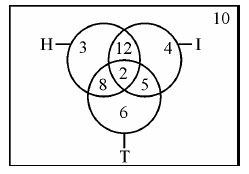
Questions from 35 - 36 are based on the following diagram in which there are three intersecting circles. 
H representing The Hindu, I representing Indian Express and T representing The Times of India. A total of 50 persons were surveyed and the number in the Venn diagram indicates the number of persons reading the newspapers.


35. How many persons would be reading at least two newspapers ?
(A) 23 (B) 25 (C) 27 (D) 29

36. How many persons would be reading almost two newspapers ?
(A) 23 (B) 25 (C) 27 (D) 48

37. Which of the following graphs does not represent regular (periodic) behaviour of the variable f(t) ?
(A) 1 
(B) 2
(C) 3 
(D) 4

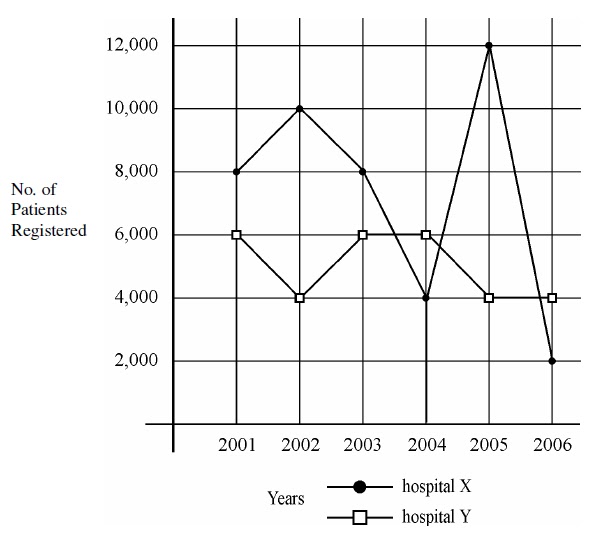
Study the following graph and answer the questions 38 to 40 :

38. In which year total number of patients registered in hospital X and hospital Y was the maximum ?
(A) 2003 (B) 2004 (C) 2005 (D) 2006

39. What is the maximum dispersion in the registration of patients in the two hospitals in a year ?
(A) 8000 (B) 6000 (C) 4000 (D) 2000

40. In which year there was maximum decrease in registration of patients in hospital X ?
(A) 2003 (B) 2004 (C) 2005 (D) 2006

[For Blind Students Only]
Read the following passage carefully and answer the questions 35 to 40 :

London’s phenomenal growth was probably at its fastest in the sixteenth century, a period when the population was growing everywhere. Many people were attracted to the rapidly growing port, which handled upto 90% of total English foreign trade and gave rise to a wide range of ancillary industries. Other sectors provided goods and services for the court, which now settled permanently in the capital, and for the growing numbers of the rich and ambitious who were attracted by court’s presence. This concentration of the wealthy made London a great leisure centre and the main purveyor of professional services, especially in medicine and law. Population growth now tended to become cumulative. More people needed even more people to provide them with goods and services that they required to survive in a large city. London was always an unhealthy place and mortality rates were much higher than elsewhere in the country, sometime rising to catastrophic heights, as in the terrible plagues of 1603, 1625 and 1665, the last of which killed 80,000 people, 1/6th of the total population of the city. Such high death rates coupled with rather low fertility, meant that London could never grow by its own natural increase. In the century after 1650, when London continued to grow but the English population remained fairly stable, immigration to the city drained the countryside of people and gave London its highest-yet population. It has probably then, in the early eighteenth century London of Defoe and Hogarth, that the city also had its greatest significance as a school centre and a school of manners and ideas for the rest of the country.

35. London’s rate of population increase was at its greatest in the seventeenth century because
(A) Its death rate was the highest in Britain at that time
(B) It was a time when the population growth was declining everywhere
(C) Migrants were drawn to London because of the vast increase in trading
(D) Its high rate of mortality was offset by a low birthrate

36. In comparison to the rest of the country, the population decline in London in the seventeenth century was as a result of
(A) frequent outbreaks of plague
(B) low rate of fertility
(C) immigration to other parts of the country
(D) movement of people to other countries

37. After 1600 A.D., the demography of London was characterised by
(A) high deathrates and birthrates
(B) three major outbreaks of disease, the last of which was responsible for the death of over 80,000 people
(C) a rise in population through natural growth
(D) population stability

38. Examples of the economic hegemony of London in the seventeenth century include
(A) the movement of the Court permanently to the capital
(B) 9/10th of England’s overseas trade passing through its docks
(C) a large variety of secondary industries growing up around the port of London.
(D) London becoming England’s major intellectual and cultural centre at the time of Defoe and Hogarth.

39. Which one of the following was not the cause of high rate of death among the people of London ?
(A) Increasing low fertility among people
(B) Absence of diseases
(C) Family planning regulations of the State
(D) Migration of population

40. What made London a great leisure centre ?
(A) Growth of ancillary industries.
(B) Concentration of wealth among people who were earlier poor.
(C) Increased rate of mortality.
(D) Due to increase in immigrant population.

41. Which of the following sources of data is not based on primary data collection ?
(A) Census of India (B) National Sample Survey
(C) Statistical Abstracts of India (D) National Family Health Survey

42. Which of the four data sets have more dispersion ?
(A) 88 91 90 92 89 91
(B) 0 1 1 0 –1 –2
(C) 3 5 2 4 1 5
(D) 0 5 8 10 –2 –8

43. Which of the following is not related to information security on the Internet ?
(A) Data Encryption (B) Water marking (C) Data Hiding (D) Information Retrieval

44. Which is the largest unit of storage among the following ?
(A) Terabyte (B) Megabyte (C) Kilobyte (D) Gigabyte

45. bit stands for
(A) binary information term (B) binary digit (C) binary tree (D) Bivariate Theory

46. Which one of the following is not a linear data structure ?
(A) Array (B) Binary Tree (C) Queue (D) Stack

47. Which one of the following is not a network device ?
(A) Router (B) Switch (C) Hub (D) CPU

48. A compiler is used to convert the following to object code which can be executed
(A) High-level language (B) Low-level language (C) Assembly language (D) Natural language

49. The great Indian Bustard bird is found in
(A) Thar Desert of Rajasthan (B) Coastal regions of India (C) Malabar Coast (D) Delta regions

50. The Sagarmanthan National Park has been established to preserve the eco-system of which mountain peak ?
(A) Kanchenjunga (B) Mount Everest (C) Annapurna (D) Dhaulavira

51. Maximum soot is released from
(A) Petrol vehicles (B) CNG vehicles (C) Diesel vehicles (D) Thermal Power Plants

52. Surface Ozone is produced from
(A) Transport sector (B) Cement plants (C) Textile industry (D) Chemical industry

53. Which one of the following non-conventional energy sources can be exploited most economically ?
(A) Solar
(B) Wind
(C) Geo-thermal
(D) Ocean Thermal Energy Conversion (OTEC)

54. The most recurring natural hazard in India is
(A) Earthquakes (B) Floods (C) Landslides (D) Volcanoes

55. The recommendation of National Knowledge Commission for the establishment of
1500 Universities is to
(A) create more teaching jobs
(B) ensure increase in student enrolment in higher education
(C) replace or substitute the privately managed higher education institutions by public institutions
(D) enable increased movement of students from rural areas to urban areas

56. According to Article 120 of the Constitution of India, the business in Parliament shall
be transacted in
(A) English only
(B) Hindi only
(C) English and Hindi both
(D) All the languages included in Eighth Schedule of the Constitution

57. Which of the following is more interactive and student centric ?
(A) Seminar (B) Workshop (C) Lecture (D) Group Discussion

58. The Parliament in India is composed of
(A) Lok Sabha & Rajya Sabha
(B) Lok Sabha, Rajya Sabha & Vice President
(C) Lok Sabha, Rajya Sabha & President
(D) Lok Sabha, Rajya Sabha with their Secretariats

59. The enrolment in higher education in India is contributed both by Formal System of Education and by System of Distance Education. Distance education contributes
(A) 50% of formal system
(B) 25% of formal system
(C) 10% of the formal system
(D) Distance education system’s contribution is not taken into account while considering the figures of enrolment in higher education

60. Assertion (A) : The U.G.C. Academic Staff Colleges came into existence to improve the quality of teachers.
Reason (R) : University and college teachers have to undergo both orientation and refresher courses.
(A) Both (A) and (R) are true and (R) is the correct explanation.
(B) Both (A) and (R) are correct but (R) is not the correct explanation of (A).
(C) (A) is correct and (R) is false.
(D) (A) is false and (R) is correct.